When it comes to the bond between dogs and their owners, few things are as crucial and heartwarming as the moment a pet enthusiastically returns to their human’s call. Imagine this: you’re in a bustling park, the air is fresh with the scent of grass, and your beloved canine companion is exploring with fervent curiosity. Then comes the moment of truth – you call their name. In an ideal world, your dog turns and bounds back to you, tail wagging, a perfect picture of obedience and loyalty.
In a world full of distractions, from squirrels darting across the path to other dogs meandering nearby, teaching your dog to reliably come back when called isn’t just a convenience, it’s a necessity. This article delves into the depths of dog recall training, unraveling the mysteries behind one of the most important commands your dog will ever learn.
If you have never heard of Fenton, see for yourself the joy of a dog who couldn’t recall away from the distraction in the environment!
So, how do you get your dog to come back when you call them? Well, it isn’t that much of a secret really, you just have to pay them! The biggest mistakes owners make are:
The other important aspects you need to be aware of with recall is it must be fun! Who wants to go back to someone who is going to tell you off for doing the right thing? The other critical thing is you have to pay the dog! If you were asked to go to work with no pay, how motivated would you be to really dig deep and go the extra mile?
If you think your dog should do whatever you say just because you have told them to, I will ask did your children always do as you told them? They are the same species and allegedly speak the same language and still things don’t always go according to plan!
Our dogs don’t speak our language and we often expect them to understand verbal cues when we haven’t actually taught them what they mean, what are we expecting?!
Verbal cues mean nothing to dogs, it is just a sound, if you have not taught them what that sounds means, how are they to know? Did you know that it takes on average a minimum of 300 successful repetitions for a dog to have a cue in their brain bank? When you teach these cues and are consistent, the dog can then understand what is expected of them and deliver.
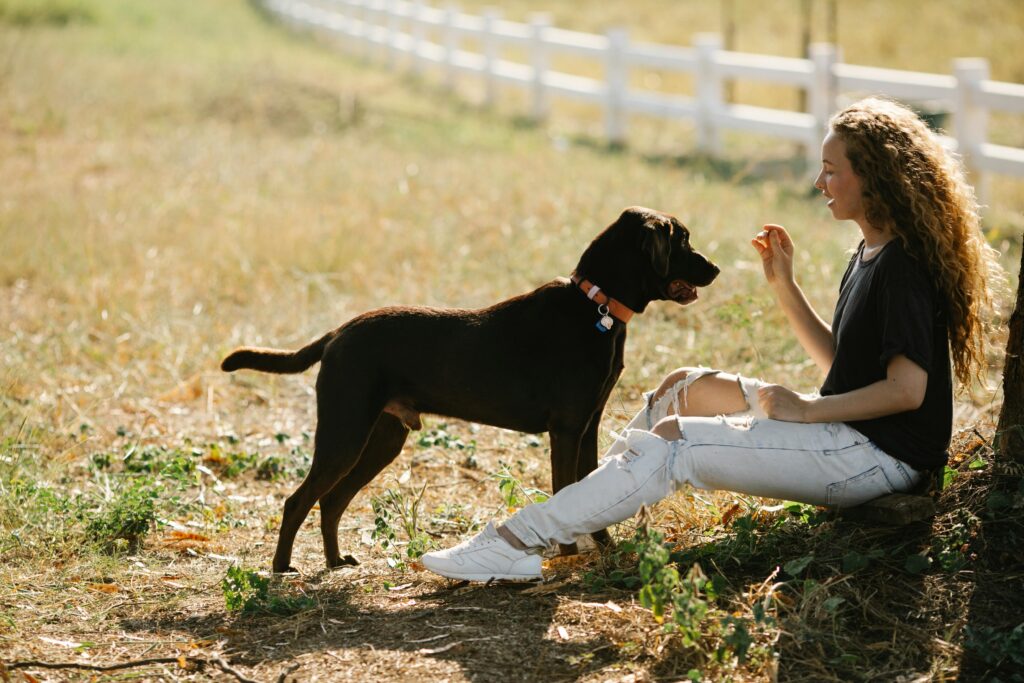
So how do you teach it? We pay, ‘Daisy Come’ translated to a response to get back to me as quickly as possible for fun, treats, and a great big party! My dog comes back to me as her history of learning is that the cue ‘Daisy Come’ is a positive one. She has always been rewarded for doing it, either with a treat, a game or love and praise to tell her she is a clever girl!
Recall is one of the main things people go to a dog trainer for as their dog once let off lead will disappear off to have some fun with the dog across the park/field or wherever you are walking. This happens mostly because we set our dog up to fail. We haven’t ‘proofed’ the recall cue.
This means the dog doesn’t really know it yet, we have let the dog get too far away from us and they are now busy with the environment, we have recalled them with an angry voice. Let’s face it we are not much fun to be around when we are like that! That dog over there is full of fun and joy, and we are cross, shouting and flustered, why on earth would a dog come back to you when you are screaming at them?
We want our dogs to learn things in a positive way, sometimes things might go a little wrong, but WE need to take responsibility for that and not blame the dog. The more we set them up for success, the better they learn!
Firstly, we pick the environment we are going to let the dog off, we don’t want a lot of distraction for them to get excited about, so pick a nice quiet spot. You should have a long line attached to the harness, so he can’t get this wrong. NEVER attach a long line to a collar, a dog’s neck is as sensitive as ours and you COULD break your dog’s neck.
The dog will not be able to practice going over to that dog on the other side of the field, so you need to have a long line but the dog should not be completely off lead. When it gets distracted, we can hold the long line and use our recall cue with an excited voice, not angry. Now we can get his attention back on us and we are going to be party central when he makes the best decision of his life and turns to come back to you!
Now, let’s tackle the bumps in the road you might encounter during recall training. Distractions? Oh boy, they’re everywhere – squirrels, other dogs, that interesting scent on the ground. It’s like trying to get a kid’s attention at a candy store! But don’t sweat it. Start in a quiet spot and gradually amp up the distractions as your pup gets the hang of it.
And then there’s stubbornness – you know, those moments when your furry friend decides they’d rather sniff around than come back to you. Stay patient and positive. Maybe up the ante with extra yummy treats or a super exciting toy. Consistency is key here – stick with it, celebrate every small win, and soon enough, your dog will be racing back to you, distractions be darned!
Training our dog should be fun. If you are not having a good time because your dog has vanished off and not listened to you, then the dog is not having fun with YOU. You can change that, being positive, reinforcing good behaviour and actually interacting and being FUN for your dog will build a stronger bond with your dog and they are more likely to listen to you and come back when called!
As dog owners we are legally responsible for our dogs and we must have control of our dog at all times in a public space. Building a strong recall is one of the most important things you can train your dog. Don’t be like Fenton’s owner, be your puppy’s champion, their hero, and their play mate! Have fun with your dogs and enjoy being able to give them freedom knowing you can recall them back to you safely!
Remember, if there’s no recall, then a longline and harness are needed. Otherwise, you should work in a secure environment where your dog cannot run up to others. The rule of thumb should always be you do NOT allow your off-lead dog to approach on lead dogs!