

I often get clients contact me and they have concerns that their dog is perhaps trying to dominate them.
This concern is often fed and encouraged by other people and sometimes by dog trainers that have not kept up with science and how our dogs learn.
This term dominance and the ‘Alpha’ was born out of a paper written by a scientist called Rudolph Schenkel who wrote a paper in the 1940’s called Expressions Studies on Wolves. David Mech then wrote a book on this in the 1970’s. David Mech’s book The Wolf; Ecology and Behaviour of an Endangered Species is one of the main reasons the dominance theory gained such attention in the general population around the world.
David Mech later said this book was in fact based on bad science. The Study of Wolves in 1948 was of wolves that had been put together in captivity and were not related. This led to the appearance that wolves when living in a family group would fight for the Alpha role and would use dominance to get it!
The truth is that our wild wolves live in harmonious family packs. The Alpha is the father, and the Alpha female is the mother, the breeding pair. When the cubs grow up at a certain stage, they head off into the wilderness to set up their own pack, just like us!
David Mech has spent years asking the publisher of this book to stop printing it, but it is still in circulation, and those that wish to use intimidation and fear to train dogs will refer to this science, even though it is known it is inaccurate. He even went so far as to take out full-page adverts in papers to ask people to stop using this incorrect data.
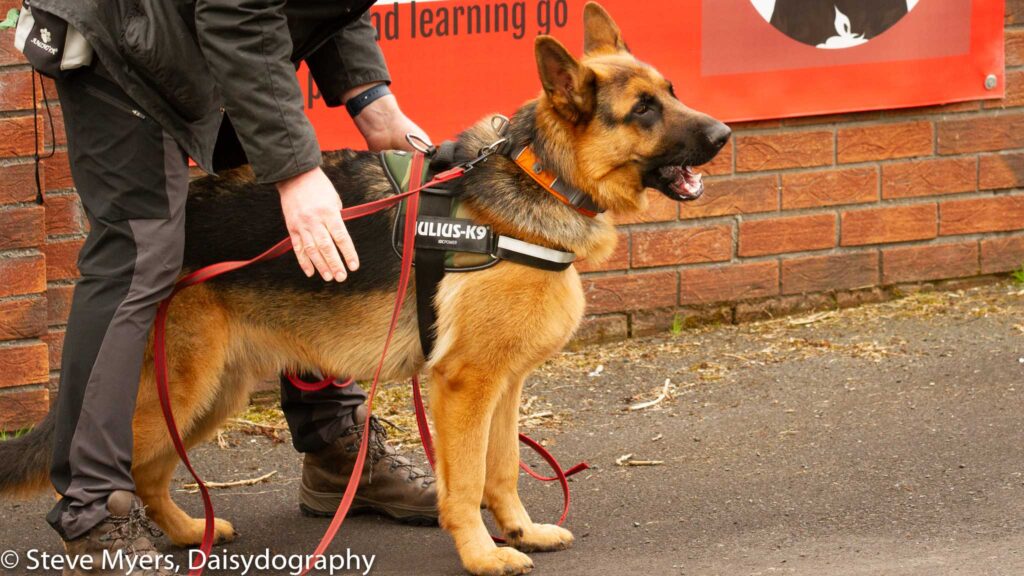
The Wolf of today is from the same ancestor as our dogs, but our dogs are not wolves; they are dogs! Dogs have no desire to dominate us and have no ideas beyond having fun and living life to the full!
The reason your dog wants to get through the door before you is because they are so excited to see the world. The modern dog as we know it today has been bred over centuries to maintain a juvenile mindset, so they never really mature into adulthood in the way wolves do. That is why you will still see a 15-year-old dog wanting to play!
When we get a dog, it is important to understand at least some things about how they learn and what will work best to get the dog you want. Positive Reinforcement is the best way to get your puppy or rescue dog to learn the things you want them to. This develops your bond and builds a wonderful, trusting relationship.
You can use punishment; there is no denying if you terrorize a dog enough it will work to get what you want, but at a very high cost to your dog and your dog’s trust in you!
There are many dog trainers that appear on TV that still talk of the dominance theory, but this just shows their lack of understanding or willingness to learn the new science, as they have made a career out of telling people their dogs are trying to take over the world!
When I hear a client say to me, ‘I will just have to be a bit more Alpha,’ I shudder! Your dog is a fun-loving, pliable creature that wants to learn and is willing to please you in any way! We are the inept ones!
No dog is trying to get one over on you, they are not wilful, stubborn, or deliberately not doing what you asked them to do even though they know full well what you said!
We are inconsistent. We bellow verbal cues at our dog that we have not, in fact, taken any time to teach them and seem to be under the illusion our dogs are fluent in our language! They do not speak English; they speak dog! When was the last time you attempted to speak to your dog in their language?
Did you know that it takes at least 300 positive repetitions for a dog to ‘know’ a cue? Even then, if you have not generalized it to lots of different locations and scenarios, there is a good chance, in a strange environment, your dog will not know what you mean.
Think about how many different people ask your dog the same cue in a different way or different accent. When family members visit and ask your dog to sit, they are saying it differently, not offering the same body language as the dog’s immediate family and yet they generally translate this and work out what you want. Our dogs are smarter than us, fact!
The next time you think your dog knows something or is doing something deliberately to annoy you, think about what you have communicated to the dog. Have you sent mixed messages? They are allowed on the sofa on a Friday night but no other night. Dogs do not know the days of the week!
Dogs do what works; if a behaviour gets them the reinforcement they want, they will do it more, even if that attention is negative. Remember your dog is never trying to take over or dominate you. They are trying to work out what you want from them and doing their best to deliver it!
Be kind to your dog, be consistent with your cues, rules, and expectations, and you will have a much happier time! You can do so much damage to your dog when you punish them for our unfulfilled expectation. They do not know what they have done! Remember the timing of our reinforcement or punishment is key.
Often punishment is given long after the dog has done something we dislike, like accidents in the house or chewing something illegal. We come home, find the dog has done something, and then punish them. The dog, of course, has learned nothing from the punishment as they have no idea how to connect the act to that situation. Dogs can only connect it to the last thing they did!
If you are struggling with a behaviour from your dog, seek out a local positive reinforcement IMDT trainer and get help. You wouldn’t attempt to fix the plumbing in your home if there was an issue, so do the sensible thing so you do not make the situation worse with Chinese whispers from everyone you meet! Everyone is a dog expert in the park, but remember, they do not know your dog!


























The Daisy Dog Academy
27 Ballynacoy Road,
Lisburn,
Co Antrim
BT28 3XW
Tel: 07919 305484
Email: info@thedaisydogacademy.com

Copyright © 2023 The Daisy Dog Academy. All rights reserved.
Site developed by ITsECPC